Showing posts with label outsourcing software testing. Show all posts

Friday, 23 October 2015

10 Common Mistakes a Software Tester Makes

Lack of Proper Planning is the biggest mistake of testers. Planning makes everything near to perfect if not perfect. Many times, we find software testers don't have any prior planning for their test case instead they directly jump for the Testing procedure. Unplanned Testing means dread of bogus application and that happens with 99% practical scenario. So, testers need to plan their Testing approach from the very beginning so that they can build a strong Testing approach for the application architecture that will definitely help them in executing the process in a well-organized manner. Moreover, they should study each and every module of the software application and accordingly prepare their plan to test those modules. Every module differs from other and so their Testing approach should be different. Let’s see the rest 9 common mistakes that a Software Tester makes during the Testing process”.

Lack of proper communication with Client and other resources:


skilled QA/Testing professional, QA/Testing services, qtp automation testing, outsource software testing, outsourcing software testing, performance software testing, qa and software testing, qa and testing services, qa software testingUsually, testers remain idle most of the time during the development process of the application. But, this is really a serious concern. Usually, client changes his requirements in between and the Project Manager discusses the same with the developers. If the tester remains isolated from the system, then he will be unaware about the modified or revised requirements of the client and this will definitely create trouble while testing the application as per his previous or outdated knowledge. So, it’s the duty of the tester to take participate in the client communication so that he will remain in touch with the application throughout the development process.

Overlooking the UML (Unified Modeling Language):

UML i.e. the core design of the application plays the most important part in software application development. It informs how the application will look in different scenarios? How it will behave in different scenarios? And how the validations should be given within the modules or forms? If anyone from the project is unaware about the core design of the application, then it leads to an inefficient way of development process and it hampers the Testing process as well. So, it is necessary to understand each and every component of the application from the core design before you start coding or Testing the application. It also makes the
skilled QA/Testing professional aware about the importance of various fields and modules of the application and gives enough scope to design his Testing approach far ahead of time.

Giving more priority to Positive Testing over Negative Testing:

This is yet another problem with testers since a long. They used to give more priority to Positive Testing and neglect the Negative Testing for the application. This is a terrific issue and can never be accepted for any enterprise standard solutions or applications. In fact, Negative Testing has more importance than Positive Testing; because with strong Negative Testing we can perform the Positive Testing without our knowledge; but the reverse is not possible! So, every tester should focus more on Negative Testing than Positive Testing. One more thing, as a smart tester you should also check for boundary value testing for better quality of Testing.

Avoiding Load Testing:

Load Testing has significant importance in web industry particularly if our application is dealing with smart phone browsers. In fact, it is necessary for every type of applications including desktop applications. Imagine an application that takes too long for a request process; then? Isn't annoying to you, and just imagine what would happen to the innocent user? He will simply close your application and look forward for a better alternative. So, it's highly recommended to create and develop highly efficient and optimized application that can really have some value for the end user. Now, it can only be possible if the application has undergone several stage of load testing during its development phase. So, every tester should be highly enthusiast to perform the load Testing; because by the process, you can end up with better user experience.

Hurry to release:

I don't know why this happens with most of the software testers? They remain idle during the development process done by the developers but try to finish the Testing at the earliest. In that way, the performance and productivity of the software tester decreases tremendously. Because the same module will need to be tested again in future when get noticed by the same tester or the client side tester. It makes the process absolutely inefficient and unorganized. It's always better to perform a single perfect Testing instead of multiple counterfeit Testing.

Cross platform or browser Testing:

Today's industry is severely influenced by the presence of modern web browsing devices like smart phones and tablets. There are many browsers available in the industry and new and innovative browsers are also getting born with time. Is your application renders properly in those browsers? Test it properly first else the user will dismiss your application. Moreover, your application should give similar user experience in every platform mostly in Android, iOS and Windows. It's the duty of software tester or web tester to test the compatibility of your application for all these platforms and devices. Cross platform Testing, Cross browser Testing and responsiveness Testing can help them out!

Never trying to learn the exact scenario:

This is yet another issue with software testers; don't know is it due to confidence or over-confidence or ignorance. Whatever the reason may be; as a smart software tester you should be cautious enough for your assignments and you should have that much passion for your job; otherwise all your effort is vague. So, before Testing make sure you are truly competent to test the application. Make sure you are the right person to test the application. This only can be possible by the virtue of your knowledge that you have earned over the application by hard study and effort.

Asking help from developers- the biggest mistake:

Imagine if the goat will make friendship with the grass; similarly, if the tester asks question to the developer to help him in testing the modules or understanding the module, then what will happen? This is absolutely wrong. From the developer's point of view, the application is good enough to go live else why should he commit the code to the production stage? So, your doubt needs not to be cleared by the developer during Testing; you can do the same before the Testing process as a smart and serious tester.

Lack of genuine intention to explore bugs:

This is really a passion and should be within every tester to be a successful one. If something that you are doing is not giving you pleasure then, it's not worth a profession. So develop the thirst within yourself to explore more and more bugs, issues and all so that the application will be more perfect and your productivity will increase.

Mindfire Solutions has been providing exemplary
QA/Testing services to its clients across industries and geographies and has carved a niche for itself in the testing domain. To avail our services to test and develop your desired applications, send in your requirements to sales at Mindfire Solutions dot com.


Tuesday, 6 October 2015

Penetration Testing: Should We Do It?

Before getting to whether we should or should not do penetration testing, we should have a fair idea of what penetration testing actually is. Most often penetration testing is confused with the likes of “vulnerability scan”, “compliance audit” or “security assessment”, but in reality it is a world apart from the above tests. Penetration testing is the type of tests which not only brings forth the vulnerabilities of developed software but at the same time, exploits these vulnerabilities to show the extent of damage that may be caused due to these flaws.

automated testing practice, certified QA/Testing, qtp automation testing, outsource software testing, outsourcing software testing, performance software testing, qa and software testing, qa and testing servicesPenetration testing may look like automated testing practice and can be conducted with the help of the automated tools available in the market, but the core of the test lies in the hands of the individual testers or the testing teams which pushes the detected short comings to its end limits. Although the highly precise automated tools are well capable of testing your software, they were made by human and the unique human mind may conjure newer techniques of penetrating your software which makes manual tests a vital part of penetration testing. The main aim of penetration testing is to detect the real world attacks that the software may face due to the pertaining security breaches that are available. It fixes a target and attacks it with various vectors to explore the probable chances of attacks that may occur.

Penetration testing is important for a particular type of software due to the following factors that gets determined by the testing procedure.

1:: It gives the developers a reality check about the feasibility of the vector sets that attack a said target.

2:: It helps in the determination of high risk vulnerabilities which occurs as a result of integration of several low risk vulnerabilities, which occur in a particular sequence.

3:: There are certain vulnerabilities which do not get detected without automated testing procedures and applications which scan the vulnerabilities of the software being tested.

4:: It helps in assessment of the magnitude of risk that may be inflicted up on the business or the software due to attacks that are successful.

5:: It helps in determining the ability of the network defenders in detecting and preventing the various attacks that may be brought up on the software.

6:: It proves why it is important to pay attention to and invest more in security personnel and technology to C-level management, investors, and customers for risk management purpose.

7:: It shows why the Payment Card Industry Data Security Standard (PCI DSS) requires both on-going penetration testing (after any system changes) as well as yearly testing.

8:: Penetration testing is essential in determining the validation of the newly engaged security system over the incumbent one. Along with forensic results, penetration testing recreates the attacking vectors in order to check if the system is prone to further breach or is perfectly capable of defending itself against further attacks (both the existing and new kinds).

So, now you see the various aspects which can be resolved with the help of the penetration testing issues. However, the true worth of the test depends on the criteria or purpose of the software that has been developed and the organization using it. It is for you to judge (taking the various purpose of your software into consideration) as to which kind of penetration testing you need to perform on your software. In case of low security software you may want to utilize the basic tests which are time saving and cost effective, but in case of high security software, you may want to avail the pro penetration testing to completely secure your software.

Mindfire Solutions has the largest
certified QA/Testing team in India and has been continuously delighting customers over the past decade with bug-free code. If you are interested to hire an experienced QA team for ensuring your codes are clean, drop in a mail with your requirements to sales at Mindfire Solutions dot com.

Thursday, 24 September 2015

Software Testing: Is It Really Necessary?

“To err is human” goes the famous saying. Yes! We are human and not God. So it is very natural for us to commit mistakes which can be reverted as well. While developing a software, it is but natural to write flawed codes which will give rise to bugs. But these mistakes can be rectified too, thanks to software testing. Software testing is the process by which the bugs and shortcomings of the software which has been developed are caught and hence rectified for the creation of a better software altogether. It goes without saying that software testing is one of the most important part of the software development life cycle and is absolutely necessary.

automated testing services, certified QA testing professionals, software testing, experienced testing teams, outsourcing software testing, performance software testing, qa and software testingAs most of the mistakes in software development are developed due to erroneous assumptions and blind spots, so detecting your own mistakes can be impossible at times. So software testing does the job for you. Usually, software testing is done by a different set of people, with different skills, than the ones developing the same and hence the mistakes are easily detected.

Following are some of the points which make software testing absolutely necessary.

1:: It helps in detection of all the bugs and glitches that were created when the coding or development of software was in process.

2:: Software testing is necessary because it helps in betterment of the software and hence helps in increasing customer reliability and satisfaction of the customers.

3:: The best way to gain the confidence of the customers is by providing them with a quality product and software testing helps you to create such products which are high in term of quality as they have been already checked for bugs which could have caused the error.

4:: Another necessity of software testing lies in the fact to check whether the software is delivering the desired results for which it had been created in the first place. Delivering a high quality product also reduces the maintenance cost of the same, thus ultimately reducing the overall cost of the process.

5:: Software testing brings forth the stress level and optimum performance issues of the software, which can be improved upon if any kind of lacking is noticed. This will help in improving the performance of the app on a whole.

6:: Software testing helps in reduction of post production error rectification. Once the software is up for mass production or has been shipped to the stores, it becomes very expensive to recall the product to revert the errors. Software testing helps in prevention of this loss.

7:: Software testing helps you to deliver quality product in a short period of time so that you can hold on to your customer base and thus make improvement in the business.

Although these are just a few points which emphasizes the necessity of software testing in the software development cycle, the whole scenario is beyond the description of words. The immense importance of
software testing is slowly being discovered and more and more companies are taking heed of the topic. If the various tests available are taken into consideration, then a software can be made absolutely flawless with the help of software testing. It also helps in the betterment of performance.

Now that you have a hang of all the necessities, you should absolutely include software testing in the product development cycle.

Mindfire Testing Practice has a unique combination of skilled software engineering &
experienced testing teams with proven expertise in testing tools and methodologies for a wide range of solutions. Should you be in need of the quality testing services at Mindfire Solutions just drop in a mail with your requirements to sales at Mindfire Solutions dot com.

Wednesday, 23 September 2015

Will Automated Testing Replace Manual Software Testing in Future?

Software testing is, in a way, the pillar of success when it comes to software development. The testing procedure starts even before the developmental test, with the help of the feasibility testing process to check the plausibility of the software and ends with the beta test which is done after the whole developmental life cycle has been completed.

automated testing services, certified QA testing professionals, qtp automation testing, outsource software testing, outsourcing software testing, performance software testing, qa and software testing, qa and testing services, qa software testingAs the importance of software testing in the software development life cycle becomes more and more evident, the myths related to the same topic are clearing up. In this age of technology, everything is being automated. Manual processes are being replaced by automation and it is a huge myth which states that manual testing of software will be replaced by the automated testing procedure in the near future. However, it is very obvious that both manual and automated testing procedures hold their importance in the software testing life cycle.

But before we get into the replacement myth, let us get a fair idea of what actually automated and manual testing are. Automated testing of software is nothing but a method by which certain coded scripts will check the software for the performance and bugs which were fitted in the code. Manual testing on the other hand comprises of a lot more than just conducting some tests. It also deals with planning the whole process and documentations of the available results.

Companies providing
automated testing services may come up with certain written codes which test your software in a mechanical manner. But it also helps in saving time and money. In cases like regression testing where you check the integration of existing system with newly added features or smoke testing where you perform basic level testing of the software, automated testing is a boon. Automated testing should be conducted anywhere which requires same kind of scripting just to see whether the system is performing as per requirement. This will save the hassle of performing step by step manual testing of the system.

But manual testing has its own importance. The primary job of a manual tester is to create the testing plan so that maximum test coverage is achieved in order to provide the customers with as bug free software as possible. There are certain parts of the software which simply can’t be tested without the manual testing procedure. They are as follows:

1. Functional Testing.
2. Usability Testing.
3. Requirements Analysis.
4. Tacit Test Procedures.
5. Domain Testing (or data testing).
6. Risk Testing.
7. Sympathetic Testing.
8. Lateral Thinking.
9. Bug Investigation.
10. Perspective/Prospective.
11. Consistency Oracles.
12. Playing.
13. Claims Testing.
14. Galumphing.

These are just the tests that have to be done in the manual process. Apart from this, manual testing also has to record and analyse the testing results for future use of the same.

After weighing the scenario, it is pretty obvious that although automated testing procedures have made a marked progress, it will never be able to completely abolish the manual testing procedure as automated testing lacks one major thing that appears to be a huge advantage of the manual testing and that is brain. The trick lies in balancing the two kinds of testing and rip the advantages of both ultimately gaining a super good software as a result.

Mindfire Solutions has the largest number of
certified QA testing professionals in India and has been providing quality software testing services since the last 15 years. If you would like to avail our expert testing services just send in your query to sales at Mindfire Solutions dot com.
Friday, 27 March 2015

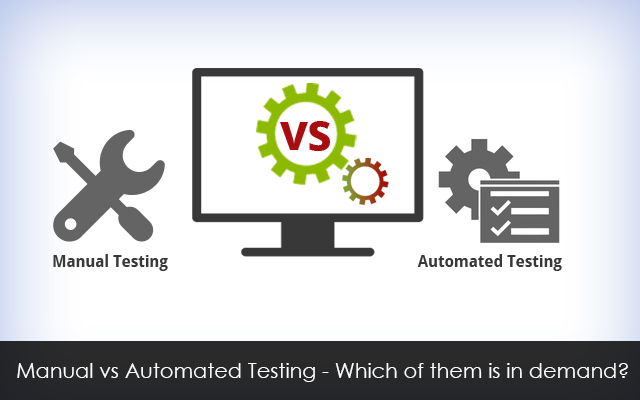
Manual Vs Automated Testing - Which of Them Is in Demand

Why Testing? Testing is the integral part of software development life cycle. It is often said that testing is the fate line for any software application or product. This indicates the importance of testing in the industry. The top IT giants of the industry give maximum priority to their testers than even developers; because they understand that tester determines the quality of the end product. Hence they don’t hesitate to hire testers at much more wages for the industry. They often believe that in order to sustain in the market with prestige, they need to provide better products and for the same the importance of testers is unique and unmatched. Anyway, today we will discuss about the two basic types of testing methodologies and their importance in the industry.

web based software Testing, Outsourcing software Testing, hire software Testing engineerManual testing: From the name itself, we can assume the meaning and procedure of the testing methodology. Manual testing is the process in which a software application or product is being tested by a person or a group of testers without any machinery or software help. In other words we can say here the testers test the application using their experience and expertise. It is the primitive way of testing any application. Though the testers give their maximum effort to make the application bug free; but, it can’t be achieved in practical; because, there must be some loopholes in the application due to the human error. Moreover, the process is damn tedious and frustrating when we have a large application on board. It becomes even more time consuming and inefficient for complicated large scale applications.



Automation testing: The automated testing is the new era testing approach for efficient and quick testing. It eliminates all the drawbacks of that of a manual tester. This testing is done by a software application i.e. automation testing tools. Hence we can expect quick process. Moreover, the tester has the option to run a testcase repeatedly to avoid irritating iterative modules; because, once the automation tester writes a testcase, he can run it any time as per the requirement of the application. This is extremely beneficial when we deal with a huge application having several common modules embedded throughout the application. Moreover, we can avoid the human error through these testing tools. Automation testing tools can save both time and money through an efficient software tool for the testing process.

Industry demands for: This is the biggest question here, isn’t? Well, the answer is simple yet little descriptive. From outside, you can say that Automation testing is best; but it is not hundred percent correct. Because automation testing tools needs some initial investment to purchase the licence for commercial use. Hence for small applications like some static applications, or some small websites, it is recommended to use manual testing, because there we have less resource and the application can be easily handled by any tester. On the other hand, for complex or large scale applications, we have to rely on Automation testers, because here we need efficient testing that will be done in less time and hence increase the productivity to large extend. Mindfire provides web based software Testing services through out testing experts who can help you build projects within allocated budgets and time schedules.

If you are thinking of outsourcing software Testing projects to India and would like to hire software Testing engineer, please get in touch with us. We would be glad to assist.

Tuesday, 17 March 2015

Testing Your Applications with Mindfire Solutions - Few Reasons

In the age of Internet of Things, enterprises have to launch modern software applications that deliver personalized and flawless user experience. That is why; a constant increase is being noted in the number of organizations hiring offshore software testing companies to yield high quality software at reduced cost and timeframe. But most companies find it a daunting challenge to hire the right offshore software testing partner. If you are looking for the expert and custom software testing services from the most reliable software testing company, it is a great idea to hire Mindfire Solutions.

Why Mindfire can be Your Organization’s Perfect Testing Partner?


independent software testing, software application testing, hire software testersFull Focus on Testing: Mindfire provides both software development and testing services. But it deploys a team of dedicated tem of QA engineers to focus on testing project fully. As the company deploys expert software testers, it can effectively handle a variety of testing scenarios. The organization has further invested in robust and secure infrastructure to effectuate the testing of a variety of applications. Along with hiring skilled software testing professionals, Mindfire further train the professionals consistently to gain industry knowledge and deliver service excellence.

High Level of Scalability: Mindfire has already impressed clients by finishing and accelerating software testing projects without compromising quality. As it has a dedicated team of testing professionals, the company can easily deploy additional tools and manpower. The high level of scalability and flexibility provided by Mindfire makes it easier for IT companies to test large and complex software applications with tight timeline and changing requirements.

Variety of Testing Services: Mindfire has already leveraged its testing solutions from a wide range of areas including content management system (CMS), customer relationship manager (CRM), healthcare, gaming and publication. So the company has testing professionals with in-depth understanding of different types of software development tools and frameworks. Mindfire further allows clients to choose from an array of testing services including general/standard, domain-based, specialized and automated testing. It further allows clients to test their application by hiring an independent QA team.

Adequate Industry Experience: As an offshore testing service provider, Mindfire has experience in testing a wide variety of applications. So the IT companies can hire Mindfire to assess enterprise applications, web-based applications, mobile applications and desktop applications. At the same time, the company has evaluated the performance of several high-traffic websites by conducting load testing. It also has a team of Mac testers who have tested different versions of Mac OS, hardware and applications.

Experience in Using Several Testing tools and Frameworks: Based on its experience in testing a variety of software application, Mindfire understands the significance of test automation tools and framework. The testers at Mindfire have expertise in using several widely used software testing tools including HP Quick Test Pro (QTP), Selenium, Robotium, Ruby Watir, Jmeter and Appium. So they can use the most appropriate testing tools to assess different aspects of the software application within the stipulated timeline. Also, the testers prefer using open source test automation suites and frameworks to control the project overheads.

Safeguards Client’s Intellectual Property: Mindfire has already invested in robust and secure testing infrastructure. The company is passionate about safeguarding its reputation and brand value. So it understands the importance of safeguarding client’s critical project information while testing the software application. Mindfire further frequently updates the security measures to eliminate the security risk associated with latest mobile technologies and cloud computing. Unlike other software testing companies, Mindfire Solutions does not believe in providing services and solutions that are not its core competencies. The company allows clients to choose from an array of software testing services according to their specific needs, objectives and budget. Test your applications by hiring testing services of an
independent software testing company that fits your budget and time.

We provide
software application testing services. If you would like to hire software testers from us, we would be glad to assist you at Mindfire Solutions.

Wednesday, 21 January 2015

The Importance of Testing for SDLC

outsourcing software testing, application software testing, hire software testersSoftware Development Life Cycle or SDLC has various types of models. Each of these models is used during the testing stage. Therefore, testing proves to be an essential component in SDLC. With the help of various types of testing including element, assimilation, user recognition and regression tests, the coders are able to provide a reliable application. The server system is any kind of system network is measured as the main terminal whereas the other procedures are considered minor terminals. Therefore, SDLC will include both the main and minor terminals while approaching the statement.

There are, in fact, various phases of testing in SDLC that are indispensable. These are vital as they help in the development of the project and clears out the glitches, if any. Here’s a short description about each stage –

Various Phases of Testing in Software Development Life Cycle

The first phase of testing is known as the inception. At this stage the engineer gets the scope to identify the major requirements for the project. The data is generally recorded and kept in the architectural reference document. The main issues tackled in this stage are information, data and system designs.

The next phase is known as elaboration. This is where the test engineers decide about the project plan. An important phase, here the complete design is being documented and stored in the System requirement document in addition to the product as well as requirement documents. In the JAD stage, commercial reviewer, planner, execution, project organization, etc are attended to.

Next comes the construction stage. At this phase, the main role is played by the programmers. They build the project as per the approved plan at the JAD phase. The testers are supposed to follow the programmers for carrying out several adjustments. Several types of faults might be overlooked or misunderstood by the programmers. At this stage it is the testers who should be solving the problems. In order to develop the HLS or high level scenario, a testing group is needed. The testers are expected to ensure that all the elements in the project adhere to the standard quality affirmation.

Finally, it is the transition phase where the errors found are tested once more by regression test. This helps in developing consistent systems.

Purpose of testing: Testing, thus, plays a major role in developing software by identifying the errors and providing solutions to solve them. This is important so that quality solutions can be delivered to the clients. Every software has bugs and they need to be fixed.

The main purpose of this process is to check whether there are any discrepancies in the development procedure. Quality cannot be sacrificed or overlooked when it comes to developing software. The resting process ensures that all the requirements are included and the final product is functional as expected. The test plan is document where all the necessary information about the project is listed. Every data required for each of the test cases are also to be found here. Thus, all the test cases can be validated in order to find out whether there are any errors in the system or the app.

Once the test plan is approved it leads to the closure of the project. Thus, the cases are quite vital for designing templates. Additionally there are scripts which are subsequently converted into the cases.

Early testing – a blessing: It should be noted at this stage that early testing is recommended for development processes. The quicker you find the bug, the better. It helps a lot of control the cost if bugs are found and fixed at early stages of the development. Moreover, if they are found early it takes lesser time to fix the issue.

In addition, if the tests are written beforehand, it helps to fix the cases at later stages. Preparing for this early also prevents the occurrence of unknown risks and there is adequate time to deal with the delays and risks.

Last but not the least, this process leads to the production of several intermediate products that can be checked to confirm whether they are meeting the standard needs of the users. Keeping user experience in mind is an essential component of this process. Hence, the software testing is an indispensable method when it comes to developing a bug free and user friendly system or app. If you are thinking of outsourcing software testing projects to offshore companies, you must evaluate them to see if they are sufficiently agile or not!

We provide application software testing services. If you would like to hire software testers from us, we would be glad to assist you at Mindfire Solutions.

Thursday, 11 December 2014

Software Testing and Its Future - Where Are We Heading?

We provide <a href=http://www.mindfiresolutions.com/web-application-testing-website-testing.htm>software testing services</a>. If you would like to <a href=http://www.mindfiresolutions.com/testing.htm>hire software testers</a> from us, we would be glad to assist you at Mindfire Solutions.Why Software testing? Every project has a chief aim to produce an outstanding and reliable product for its end users and so the case for any software application or product. While the developer develops different modules of a software application he understands the program flow and the logic of the application. But the end user is totally unaware of the logic section. Hence, the end user may find it difficult to browse the application without understanding the background logic. To create a virtual connection breeze between the developer and end user there is a set off people known as testers. Testers check the application from the user’s point of view to provide better user experience to the end user. So in order to get a good reliable and user friendly product we must give importance to the testing operations for an application.

Future of software testing: Previously the testing operation was performed by QA testers i.e., quality assurance professionals. They use to test the application manually with their experience, expertise and knowledge. This is really a tedious job for the testers to check each and every aspect of the application manually which is not only time taking but also an inefficient process. Understanding the same, the automation testing gets evolved in 21st century. With different automation testing tools like QTP testing, selenium testing etc; it makes the overall testing experience a pleasant one with efficiency and time saving.

Why future rely on automation testing? With the rapid progress of the smart phones and tablets in the industry, the testing process becomes extremely difficult for a tester to check the reliability of an application in different platforms like Windows, Android and IOS simultaneously. To achieve the same if a QA tester tests the application manually then it would be a tough and inefficient method for the application because the tester may leave some loop holes in the application which may lead to crash of the application while being used by the user on different platforms. To avoid this embracing situation, the future testers are depending on the automation testing tools for efficient testing. Automated testing can help in not only decrease in the effort for the tester but also at the same time increases the efficiency and productivity.

Different types of automation testing tools: There are basically two different popular automation testing tools namely Selenium Automation Testing and QTP Automation testing tools. Well both maintained their own priority in respective fields but this is the duty of the tester to choose the best testing methodology for his project considering the cost, type and size of the application. QTP automation testing can be used for any application for windows platform. It needs the knowledge of VB script for the tester to make the automation testing successful for applications for windows platform. On the other hand, Selenium is a modern era automation testing tool which can be used for only web application testing but for all platforms i.e., Windows, Android, IOS. Moreover Selenium automation testing is an in expensive way of automation testing due to its low cost of ownership.

Hence, for any software application testing except web applications we can rely on QTP automated testing whereas for modern web applications testing that run on Android or IOS platform, Selenium automated testing is a boon. Test your applications by hiring testing services of an application software testing company that fits your budget and time.

We provide software testing services. If you would like to hire software testers from us, we would be glad to assist you at Mindfire Solutions.

Monday, 3 June 2013

What should your Testing Checklist Contain?

Before we make our websites public we must get things right. I have jot down a few points in my checklist to keep in mind a website must have before it is published to the web. Any site more or less must be usable and attractive and should explain its presence as well. Common problems that designers face by addressing their own sites in a Usability checklist of sorts. We work on many things like interacting with requirements of projects with clients, designing prototypes, coding, programming and testing – there’s a lot to keep track of and a lot to make sure gets done for the completion of a successful project.

Points to remember for a Testing Checklist:
  • ID: is the identity of the site, it is usually found at the top left of a page right next to navigation of any kind. It’s also very important that the ID links back to the home page of the site, or at least add a “Home” link in the navigation on sub pages of a site.
  • Page Name: is as important as the Site ID, the Name of any page being browsed needs to be made very clear to the user. It must define the page content or what the page wants to narrate. It must be framing the content unique to that page, prominently placed and styled to show that it is indeed the page heading. The Page Name is often the largest text on the page which clearly emphasizes its importance.If the name of a page matches the text linking to the page, a user will have no trouble identifying what page they are on.
  • Navigation: is a must for a site, and it must be constant throughout all the pages. So that users can quickly browse through whatever information at a glance without any usability issue. There are two types of navigation primary and secondary ones.
  • Primary Navigation: contains the parent pages of the site, main parts of the site. It is a top level navigation, explains to the user what the main sections of the site are and helps them get to those sections. Usually the Primary Navigation is a part of a site's global navigation.
  • Secondary Navigation: divides primary navigation into subsections. Tertiary Navigation divides those subsections into even more sections and so on. Structure your navigation by keeping it simple in all the pages of the site. So that people can easily run around the sub-menus and main menus.
  • Utilities: are parts of your site that don't really get connected to the primary sections of your site. Examples of utilities include: About us, Contact Us, Privacy Policy, Terms of Use, etc. Be sure to include the most important ones for your site in a place where your viewers will easily find them, but don’t make your navigation too crowded by including lots of utility navigation links.
  • Navigation by Search: There are users who don't have time and search for the pages which they need to focus on so they directly search for those pages only which they need. It is the second form of navigation pretty much every site should have is navigated by searching. Some users prefer browsing, some prefer searching, so it’s usually wise to include both.
  • Current Location: We must highlight the buttons we are currently working on though a nice page title isn’t quite enough to tell a viewer where they are on a website. So that users are aware of where they are in relation to everything else.Signs all over large airports that clearly mark your location as well as locations of all the other important places.
  • Highlighting: In many ways a website is like a large airport. The viewer doesn’t really know how big the site is and without some sort of grounding a user will have a tough time placing themselves on the map. Some sites highlight the section of a site a user is about to explain to them where they are, while other sites may use breadcrumb navigation or other means to show the viewer where they are on the site. Perhaps one is more useful than the other in certain situations, but the point is a site should somehow always show the user where they are in relation to everything else.
  • Tagline: Taglines are a great way to explain the purpose of a site to a user quickly. They are useful because it gets the messages across. It’s just a small, well crafted summary about your site that’s shown right next to the Site ID, usually no more than a few words. Taglines are not mottos which describe the motivation or intention, but instead descriptions that convey the point of something. They are critical because people scan websites, especially first time visitors who are just beginning to understand your company.
  • Clear Visual Page: We must not forget the fact that content is the king of any website. It should be clear and precise. Content on a page isn’t something to be taken lightly. Newspapers as a classic example of how a content hierarchy should appear online. Well constructed pages using clear headings to organize content and subheadings to make that content easier to read and appear. User should not get lost inside page, content need to be relevant up to date and well organized and should be written uniquely for each page of your website and should be written as if you are talking to the customers.
A very good website must engage the customers spend more time on their pages engages the readers, increase search engine rankings and traffic and promotes the likelihood of quality links from other sites. For a successful website it must attract both the visitors and search engines. Testing plays a critical role in the development of any web site and its long-term maintenance. While smaller web sites—especially those with more limited budgets—may not need to follow the formal testing procedures that are required for large-scale, commercial web sites, every site needs to be thoroughly tested to ensure that it’s error-free, user-friendly, accessible and standards compliant.

The Testing checklist above will help you test your site both during development and after. We must crib for a very good website liked by all and gets more demanding by them. All information should be up-to-date, with new technology being used and new techniques. Planning, Design/Layout, Usability/Accessibility, Content, Website Optimization/Standards and Search Engine Optimization/Marketing these play a vital role in a site's success. If we are alert in these areas while developing our own site, then nothing can beat us from being successful and more wanting among the professional and novice users. So if you are looking to hire offshore software testing partners, make sure they follow these testing checklists.

We provide web application testing services. If you would like to know more about our expert software testers, please get in touch with us at Mindfire Solutions.